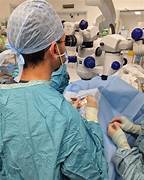
Our Glaucoma Department focuses on diagnosing, managing and treating all types of glaucoma utilizing advanced technology and a team of experienced specialists, we provide comprehensive care of patients with varying stages of the disease, by effectively controlling intraocular pressure and thus visual loss.
Our team with the help of state of the art diagnostic tools like visual field analysis, OCT,
tonometry etc. accurately asses the disease and its progression and offers a range of treatments
including medications, laser treatments, various surgical procedures like trabeculectomy
,minimally invasive glaucoma surgery (MIGS-GATT and KDB) and various drainage implants
like i stent, (gonioscopy assisted transluminal trabeculotomy and kahook dual blade)

Dr. Arvin Ponnat
Trabeculectomy
An incisional surgery that creates a new pathway for fluid to drain from the eye.
This procedure is often used for patients with severe glaucoma. However, it has
a lengthy recovery period and serious risks, including hypotony, haemorrhage,
and infections
MIGS
A procedure that lowers intraocular pressure (IOP) by altering the dynamics of
aqueous humour. MIGS can bypass the trabecular meshwork using a stent or
by surgically altering tissue.
GATT
Goniotomy with Ab-Interno Trabeculotomy is a minimally invasive glaucoma procedure that improves
aqueous outflow by targeting the trabecular meshwork. It involves a small incision to access the anterior
chamber, allowing for a goniotomy followed by an ab-interno trabeculotomy. GATT offers a less invasive
alternative to traditional glaucoma surgeries, with a quicker recovery and minimal of complications.
iStent
A minimally invasive glaucoma device designed to reduce intraocular pressure. The procedure involves
implanting a small titanium stent into the eye’s drainage angle, allowing fluid to bypass the trabecular
meshwork. It can be performed during cataract surgery or as a standalone procedure, offering a safe
option with a rapid recovery and minimal risk of complications, ultimately improving patient outcomes and
quality of life.
• Humphrey Field Analyzer (HFA)
• Optical coherence tomography (OCT - RNFL)
• Pachymetry
• Carl Zeiss Lumera operating microscope
• IOL Master 700
• Alconbury Centurion Phaco Machine
• Johnson & Johson veritas Phaco machine.